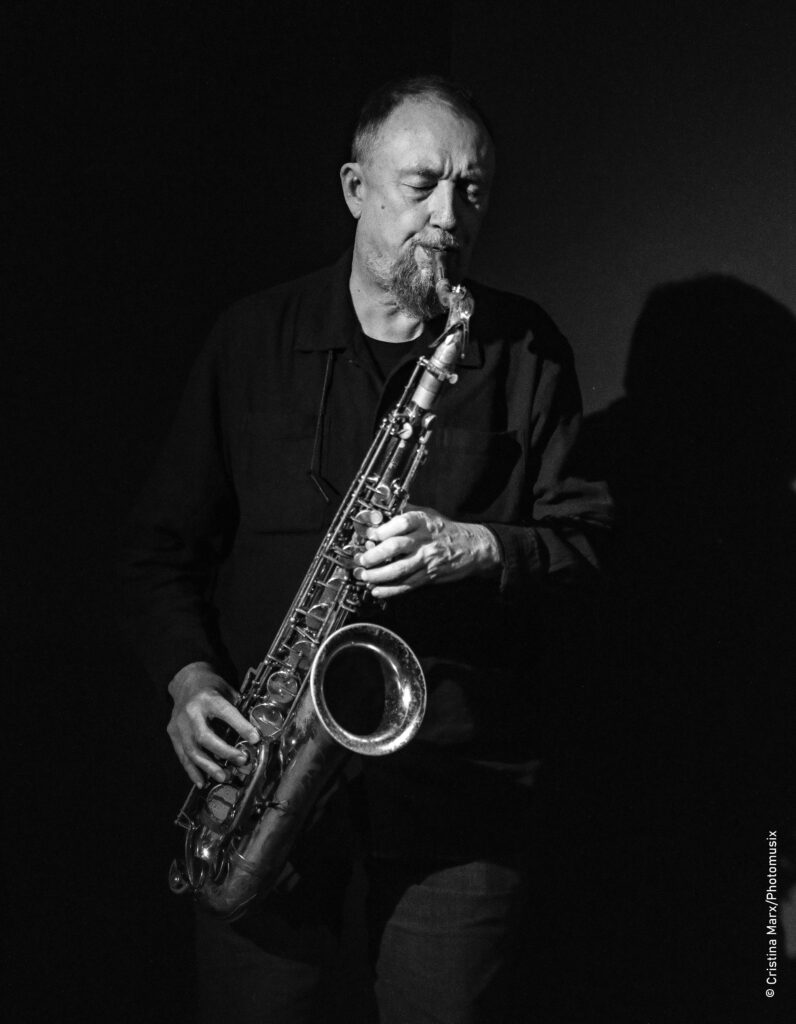
Born in Brighton and living in London, John Butcher is a saxophonist whose work ranges through improvisation, his own compositions, multitracked pieces and explorations with feedback, unusual acoustics and non-concert locations. He is well known as a solo performer who attempts to engage with a sense of place. Resonant Spaces, for example, is a collection of performances recorded during a tour of unusual locations in Scotland and the Orkney Islands.
Butcher originally studied Physics, but after publishing a PH.D (1982) on quantum chromodynamics he left academia and took off with music. He has since collaborated with hundreds of artists, some for many decades, including Derek Bailey, Eddie Prévost, John Stevens’ Spontaneous Music Ensemble, Okkyung Lee, Andy Moor, Sophie Agnel, Christian Marclay, Angharad Davies, Pat Thomas, Phil Minton, Rhodri Davies, Tony Buck, Magda Mayas, John Russell, Chris Corsano, Steve Beresford, Ståle Liavik Solberg, and Matthew Shipp.
Additionally he values occasional encounters – with large groups ranging from the WDR Sinfonieorchester (as soloist), and the 20+ piece EX Orkest to duos with Akio Suzuki, Liz Allbee, Keiji Haino, Isabelle Duthois, David Toop, Fred Frith and Joe McPhee.
Recent compositions include “Fluid Fixations” (an hcmf commission), “Penny Wands” for Futurist Intonarumori, “Good Liquor…” for the London Sinfonietta and “Tarab Cuts” (shortlisted for a British Composer’s Award).
John Butcher is without question the most jaw-dropping technician we’ve ever heard wielding a tenor, equally capable of brawny assault and textural meditations at the very edge of audibility. What makes him so compelling, though, is the taste and poetry behind everything he does.”
Time Out – New York.
Over 40 years of sustained performance and publishing, English saxophonist, improvisor and composer John Butcher has shaped much of what soprano and tenor saxophone can do, and what their roles and vocabulary in improvised music might be.
I’ve always heard Butcher’s playing as a kind of nose-to-tail saxophony, where the whole instrument from reed-tip to brim of bell is available, accessible and articulate. Few other saxophonists slice as sharply back into the physical history, material (and physics) of the instrument, across its near 200 year history. When Hector Berlioz wrote of his friend Adolphe Sax’s then fresh invention, “the varied beauty of its accent, sometimes serious, sometimes calm, sometimes impassioned, dreamy or melancholic, or vague”, he could have been imagining Butcher’s distinctively clean but complex, enquiring soundworld.
WIRE – October 2024. The Primer by Seymour Wright
In the hands of London improvisor John Butcher, the saxophone can sound like anything, from a piece of hollowed out brass baubled with pads and valves to a hermetically sealed feedback system, a miniature sound environment teeming with ever-evolving note-forms, or a huge echo chamber inflicting dub scale damage on every breath.
His conceptions are invariably built around techniques designed to overcome more than a century of accrued musical and cultural baggage, utilising a variety of invasive and exploratory processes, including cranked amplification, close-miking and overdubbing, in a bid to rethink the instrument.
As a player he regularly draws on the saxophone’s most peripheral capabilities, recasting fingering patterns in terms of percussive codes, turning naturally occurring acoustic phenomena into virtual accompanists and making expressive use of ghost tones and accidentals.
The Wire – David Keenan
“Extraordinarily powerful, Butcher’s saxophone may test the limits of one’s ear to make sense of the close and complex relationships that are put forth, but there’s an undeniable emotional depth and sheer beauty in his work that supersedes technicality and concept.”
Tiny Mix Tapes.